Table of contents
TL;DR Summary
Thinking about becoming an electrician through the IBEW apprenticeship? Before you commit to a 4–5 year union program, it is worth knowing all your options. This guide breaks down exactly how the IBEW apprenticeship works, what it costs, and how it compares to attending a California-approved trade school like InterCoast College — where you can graduate in under a year, earn your Electrical Trainee (ET) card, and begin working while you study.
According to the U.S. Bureau of Labor Statistics, the median annual wage for experienced electricians was $62,350, with 762,600 jobs recorded and a projected 11% growth through 2033 — adding approximately 80,200 new openings every year. With surging demand from data centers, renewable energy projects, and large-scale commercial construction, skilled electricians have never been more in demand. Requiring only a high school diploma or equivalent and apprenticeship training, this career is accessible and appealing for anyone seeking a stable, hands-on profession.
If you are thinking about becoming an electrician, one of the first things you may consider is an electrician apprenticeship with IBEW. Read on to learn why this is not the only choice for your career and why attending a California-approved trade school may be a better option for you.
What is IBEW?
The International Brotherhood of Electrical Workers (IBEW) is a labor union representing approximately 775,000 workers in the electrical industry. Apprenticing under the IBEW provides hands-on education with on-the-job training and in-class lessons.
The disadvantages of this seemingly easy route to a good-paying career could outweigh the benefits. Understanding both sides of the equation will help you make the most informed decision possible about your electrician career path.
What Is an Electrician Apprenticeship?
An apprenticeship is a long-term training program. These are generally run by professional organizations combining work and instruction. The apprenticeship requires a certain amount of in-class and hands-on experience, the duration of which depends on your specialty.
Apprenticeships generally take about 4½ to 5 years to complete. You have two options when looking to complete an apprenticeship:
- Apply directly to a professional group, and if you receive acceptance, begin the program
- Attend an electrician school, receive professional classroom and hands-on training as an electrical assistant, and apply for an apprenticeship from a stronger, more competitive position
The Hybrid Electrical Training Program at InterCoast College provides a combination of on-campus hands-on instruction, simulated projects, and online assignments you can complete from home. You will also participate in real-world practice in the labs at the school one day a week, giving you a well-rounded education that prepares you for the field quickly.
Active students receive an Electrical Training Card (ET), which allows you to work while attending school. You graduate in less than one year — a significant advantage over the multi-year IBEW commitment.
IBEW vs. InterCoast Trade School
When weighing whether you should join the IBEW or attend a trade school, carefully consider the following eight factors:
1. Getting an IBEW Apprenticeship Can Be Difficult
When applying for membership in the International Brotherhood of Electrical Workers (IBEW), it is essential to understand the competitive nature of the process. As one of the most sought-after opportunities in the field, the IBEW attracts many applicants while the number of available openings remains limited. The apprenticeship program is a rigorous commitment lasting 4–5 years and demands unwavering dedication and a significant investment of time.
Compared to the comparatively shorter duration of joining a trade school, embarking on an IBEW apprenticeship entails a profound commitment to honing one's skills and expertise. This immersive program ensures that only the most competitive candidates are selected to join the ranks of skilled electrical professionals — which means many qualified applicants are turned away each cycle.
InterCoast College offers a comprehensive Electrical Technician Training Program that covers the fundamentals of electricity, power distribution, trade mathematics, and electrical code requirements. It prepares students for a fulfilling career as an electrician in just under a year. With the Hybrid Electrical Training Program available, students enjoy the convenience of both on-campus and online study, allowing them to gain hands-on experience while continuing to work.
2. Application Requirements
To participate in the IBEW apprenticeship program, you must be 18 by the time of selection and indenture. Other requirements may vary by local, but usually include the following:
- Have a High School Diploma or GED
- Have and maintain a valid driver's license
- Have a passing grade for one credit of high school algebra or one semester of college algebra
- Be in good health
- Have a qualifying score on their aptitude test
- Be drug-free
The first step to becoming an electrician is to complete your high school diploma or GED. InterCoast College provides an opportunity for you to receive your high school diploma at the same time you are attending their electrical program. So, you can start the InterCoast program without a high school diploma or GED already in hand. For more information on this great opportunity, call (877) 227-3377.
3. Select a Specialty When Applying
When applying to IBEW, you are often required to select the area in which you want to specialize:
- Residential Wireman — Installing electrical systems in residential areas, a 3-year program
- VDV Installer Technician — Installing circuits and equipment for low-voltage systems, a 3-year program
- Outside Lineman — Installing distribution and transmission lines, a 3½-year program
- Inside Wireman — Working in commercial and industrial settings, a 5-year program
When making this selection at the time of application, you are locking yourself into one area of specialization before you have had a chance to explore the field.
When you attend InterCoast College, you learn about various areas of the field, putting you in a better position to select the specialty you truly want. You acquire a wide range of work-related skills, making you more employable across multiple sectors — including the fast-growing data center and renewable energy industries.
Safety is important to all training programs. Studies of fatal electric shock incidents have found that, on average, approximately 125 people died per year from electrical fatalities on the job. You will learn proper safety protocols during your studies at InterCoast College.
In addition to safety procedures, you will also be learning the National Electrical Code. This is critical knowledge you will need when taking your journeyman exam.
4. IBEW Entrance Test May Be Required
You may be required to participate in an interview and take an entrance exam for admission to the IBEW. Math and algebra are a requirement for any electrician, and the IBEW entrance exam focuses heavily on these subjects.
While the specifics of the test can vary slightly by local union, it typically covers the following subjects:
- Math Skills: This part of the test measures your knowledge of algebra, including basic operations with polynomials, factoring, linear equations, and systems of linear equations. You may also see questions on ratios and proportions. The IBEW aptitude test's math section consists of 33 multiple-choice questions that must be completed within 46 minutes. It covers whole numbers, fractions, decimals, integers, rational numbers, exponents, algebra essentials, equations, formulas, and inequalities.
- Reading Comprehension: The test's reading section typically includes passages followed by questions about those passages. The questions test your ability to understand and interpret written material accurately and efficiently.
- Aptitude and Personality Assessment: Some test versions may include sections assessing your aptitude for electrical work and personality characteristics. This could include questions about your work habits, attitudes, and preferences.
It is recommended that you prepare for the test by reviewing relevant math concepts and practicing reading comprehension. There are study guides and practice tests available that can help you prepare for the IBEW entrance test.
Remember that the specifics of the test can vary locally and over time, so it is best to check with your local IBEW chapter for the most accurate and current information.
The IBEW aptitude test has a passing score of 4 out of 9. However, that means you need to be in the top 45% of all test-takers to be moved further in the apprenticeship process. This is a significant hurdle that eliminates many motivated, capable candidates before they ever begin training.
Even if you later desire to join the union, going to an electrician school first could provide you with the instruction and certifications necessary to be accepted into their organization. Going to a school for training and working as an electrical trainee gets your foot in the door for possible jobs. As an electrician trainee, you will meet other electricians who can help you obtain an apprenticeship down the road.
Attending a trade school also sends a clear signal to employers that you are serious about your career. You will have real-world experience in the field as a trainee before entering any apprenticeship program.
5. Fees and Dues
The amount of dues charged by the International Brotherhood of Electrical Workers (IBEW) varies by local union and is often tied to members' gross wages or membership type (e.g., "A" or "BA" members). Dues typically include a basic monthly fee, a per capita fee allocated to the IBEW International Office, contributions to the IBEW Pension Benefit Fund (for "A" members), and other local-specific fees, such as those for the Electrical Workers Death Benefit Society or administrative costs.
As of July 1, 2025, the international portion of dues for "A" members is $48.00 per month, following incremental increases approved at the 40th International Convention in May 2022: $44.00 in January 2024, $45.00 in July 2024, $47.00 in January 2025, and $48.00 in July 2025. For "BA" members, the per capita dues are $24.00 per month as of July 1, 2025. Local union dues and additional fees vary, with examples like IBEW Local 343 charging $144.00 per quarter for "A" members starting January 1, 2025. Members should check with their local union for specific rates and fee breakdowns. (cf: https://ibew405.org/pay-dues/, https://ibew.org/our-departments/per-capita-membership/, https://www.local3ibew.org/local-3-dues)
For example, IBEW Local 18 in Los Angeles does not impose initiation fees, fostering inclusivity and encouraging broader membership. Members contribute 1% of their monthly salary as local union dues, ensuring fair and proportional support.
Even so, these dues can easily add up to several hundred dollars per year. A $200 initiation fee must also be paid upfront by new union employees in many locals.
These dues apply only to IBEW members; electricians who graduated from trade schools do not have these ongoing dues. If you are concerned about the cost of education at InterCoast College, it is important to know that financial aid is available to those who qualify. With the right resources and support, you can pursue a well-rounded education without sacrificing your financial stability.
6. Call Board Employment
When you work for the IBEW, you typically do not select your work location. You may find yourself sitting at the union hall and waiting for your turn to work. When a contractor calls and needs workers, people are dispatched on a call board rotation system.
You also usually do not select your employer. Your wages are paid by the union, which deducts your dues from those wages.
If you desire to work for yourself, being an electrician is a great career choice. Many electricians eventually become self-employed, working as independent contractors or owning their own electrical contracting companies. As a self-employed electrician, you can choose what jobs you want in the locations you want, work the hours you want, and earn an income you set — all depending on the contracts you take and the hours you work.
7. Obtaining Journeyman License
When you participate in the IBEW program, you typically take 4–5 years to complete your apprenticeship. This means you are effectively locked into working within the IBEW system during that entire time.
An electrician does not need a four-year college degree nor a 4–5 year apprenticeship commitment. Completing an electrical program at a college or trade school provides an excellent option for strong career opportunities in a much shorter time frame.
You can decide to participate in an apprenticeship program, but it is not necessary in order to sit for the journeyman exam. Students who complete the InterCoast Electrical Training Program are qualified to sit for the Journeyman examination. Keep in mind that the Journeyman license does not allow you to work independently right away; you must first log a set number of hours working under a licensed electrician's supervision.
The time it takes to become an electrician varies depending on your goals. If you want to become an electrical contractor and own your own business, you will need a C-10 license to work as a contractor in California.
Most states have journeyman and master electrician licenses. California offers a variety of licenses depending on your work specialty, and each license type has different requirements for hours worked, on-the-job training, and separate exams. According to Research.com's 2026 guide on becoming an electrician in California, understanding the specific licensing pathway for your specialty is a critical early step in planning your career.
8. Lack of Flexibility
If you are not a union member, you can negotiate aspects of your employment independently of any union. If you only want to work certain hours or part-time, attending a trade school can greatly benefit you.
One of the key benefits of attending a trade school is learning skills such as time management, budgeting, and communication — all of which will assist you in negotiating your own jobs if you choose to work independently. Working through a trade school program allows you to work part-time during training, giving you both in-class and hands-on experience simultaneously. Additionally, if you decide later to become self-employed, you can stay on friendly terms with past employers and negotiate your own wages and requirements on your terms.
Why Electrician Demand Is Surging in 2026
The electrician job market has never been stronger, and several major industry trends are driving significant new demand for skilled workers. Understanding these trends can help you appreciate why now is an excellent time to enter this field — and why having your certifications in hand quickly matters.
Data Centers: The explosive growth of artificial intelligence, cloud computing, and streaming services is creating an enormous demand for electricians. Data centers require complex, high-capacity electrical systems, and industry leaders note that this sector alone is generating thousands of new jobs for licensed electricians. According to reporting from Technical.ly, union leaders in markets like Maryland are highlighting data center construction as one of the primary drivers pushing demand for newly trained electricians to all-time highs.
Renewable Energy: Solar panel installation, wind energy infrastructure, and EV charging station buildouts all require licensed electricians. The green energy transition is expected to sustain elevated demand for electrical workers well into the 2030s.
Infrastructure Upgrades: Aging electrical grids, new residential developments, and large commercial construction projects continue to create consistent openings nationwide. The BLS projects 11% job growth for electricians through 2033 — significantly faster than the average for all occupations.
Getting into the workforce quickly — as InterCoast's under-one-year program allows — means you can start capitalizing on these opportunities years ahead of someone completing a traditional 4–5 year IBEW apprenticeship.
Frequently Asked Questions About IBEW Apprenticeship vs. Trade School
Q: How long does the IBEW apprenticeship take?
A: The IBEW apprenticeship typically takes 4 to 5 years to complete, depending on your chosen specialty. Residential Wireman and VDV programs take approximately 3 years, while the Inside Wireman program takes 5 years.
Q: How long does the InterCoast electrical training program take?
A: InterCoast's Hybrid Electrical Training Program is designed to be completed in under one year. This allows students to enter the workforce — and begin earning — much faster than through a traditional union apprenticeship.
Q: Can I join IBEW after attending a trade school?
A: Yes. Attending a trade school like InterCoast College does not prevent you from joining the IBEW later. In fact, having completed a formal training program may make your application to the IBEW more competitive, since you will already have foundational knowledge and practical skills.
Q: What is the IBEW aptitude test?
A: The IBEW aptitude test evaluates candidates on algebra/math skills and reading comprehension. It consists of 33 multiple-choice math questions to be completed within 46 minutes, plus a reading comprehension section. The passing score is 4 out of 9, but only the top 45% of test-takers are advanced in the selection process.
Q: Do I need a high school diploma to apply to IBEW?
A: Yes, a high school diploma or GED is required for IBEW apprenticeship admission. InterCoast College, however, allows students to enroll in the electrical program while simultaneously completing their high school diploma — so a diploma is not required to start.
Q: What does an electrician earn in 2026?
A: According to the U.S. Bureau of Labor Statistics, the median annual wage for electricians was $62,350. Top earners — especially those with specialized skills in areas like data centers or renewable energy — can earn significantly more. According to the 2026 Electrician Annual Salary Guide from Repair-CRM, wages for experienced electricians in high-demand markets are continuing to climb.
Q: What is an Electrical Trainee (ET) card?
A: An Electrical Trainee (ET) card is issued to active students enrolled in a California-approved electrical training program like the one at InterCoast College. It allows students to legally work in the electrical field while they are still completing their training, giving them the ability to earn income and gain practical experience simultaneously.
Q: What is the difference between a journeyman and a master electrician?
A: A journeyman electrician has completed their required training and passed the journeyman exam, but must work under the supervision of a licensed electrician for a set period before working independently. A master electrician has additional experience and has passed a higher-level exam, allowing them to work independently, pull permits, and in many states, supervise journeymen. California has its own specific licensing structure based on work specialty.
Q: Is IBEW membership required to become an electrician?
A: No. IBEW membership is not a requirement to work as an electrician. Many successful electricians work for non-union contractors, operate their own businesses, or pursue careers in specialized sectors without ever joining the IBEW.
The Pro Series
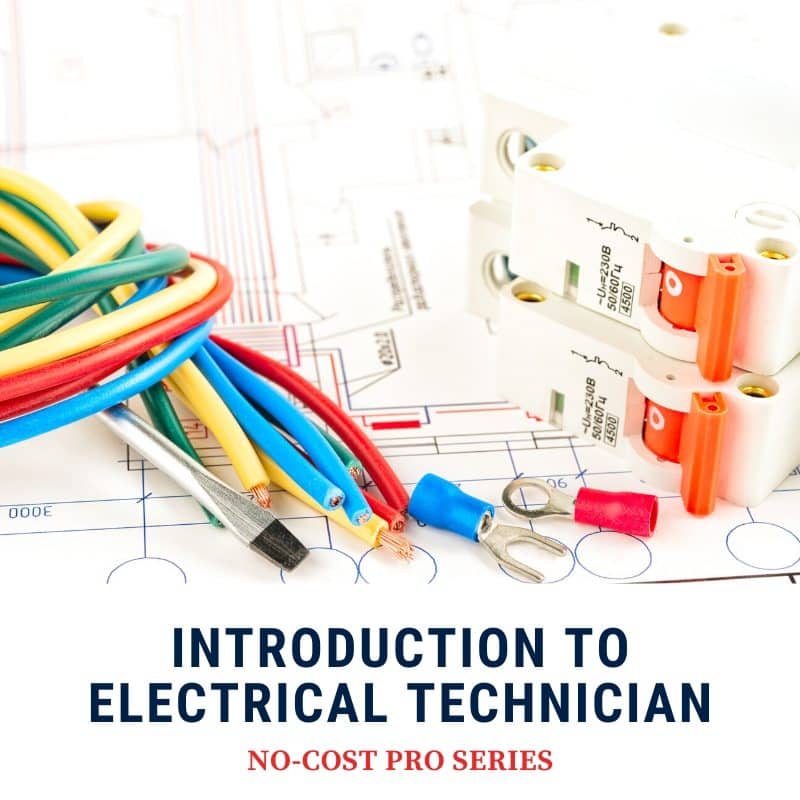
InterCoast College's no-cost Pro Series class is a great option for getting a head start on your electrical career — with no commitment required.
Taking the form of a series of videos, this course provides an in-depth look at an electrician's equipment, current career projections for the field, and a downloadable ebook that you can reference anytime.
It is designed specifically to cater to beginners without any prior knowledge of what an electrician does, making it accessible and approachable for anyone considering the field.
The course is completely self-led, meaning you can take as much or as little time as you would like. There is no deadline and no pressure — just valuable, career-building information available to you whenever you are ready.
Start Your Path to Becoming an Electrician Today
If you are still in high school and want to start your electrical training now, contact InterCoast College to help arrange the necessary steps. You can begin preparing for your future career by taking subjects in high school that are relevant and useful for electricians — including additional math, shop, and mechanical drawing.
To further your education in the field of electrical work after completing high school, consider enrolling in InterCoast's college program. This provides valuable knowledge and hands-on experience that will help you advance in your career from day one. As an active student, you will receive an ET card and have the opportunity to gain work experience while receiving your training — a significant advantage over programs that require you to wait years before stepping onto a job site.
With the electrician field growing at 11% through 2033 and demand being fueled by data centers, renewable energy, and nationwide infrastructure upgrades, there has never been a better time to start. The sooner you begin your training, the sooner you can be part of one of the most in-demand trades in the country.
For more information, subscribe to our YouTube channel and download our no-cost E-Book "What is a Trade School." Both resources are free and designed to help you make an informed decision about your career path.
Contact InterCoast College today — simply click the banner below or call us at (877) 227-3377 to get all your questions answered by an experienced admissions advisor.
With thousands of enrolled students over 35 years of operation, InterCoast College has helped countless individuals launch successful careers in the electrical trade. Whether you are a recent high school graduate, a career changer, or someone looking to build a more financially stable future, InterCoast College is here to help you get there — faster, more affordably, and with the flexibility today's working adults need.